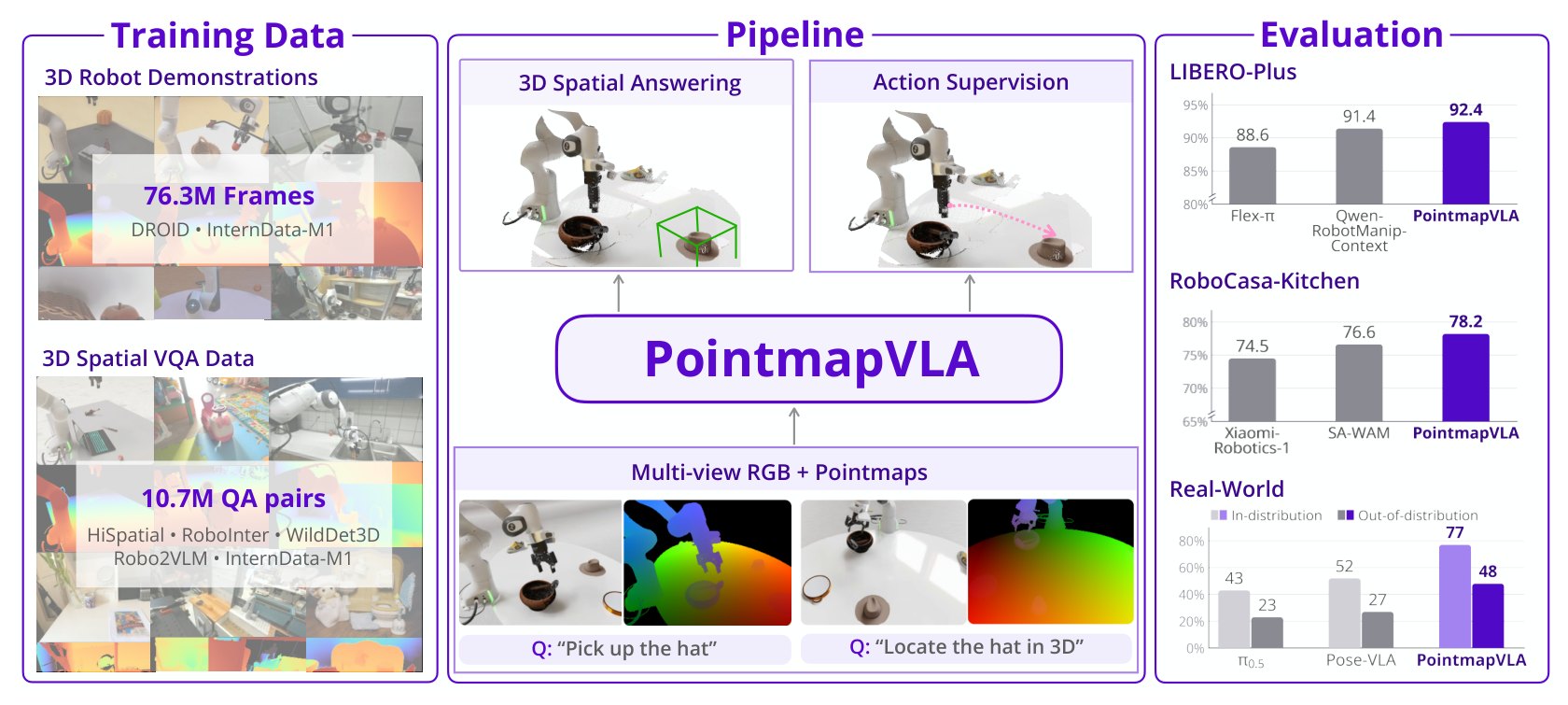
TL;DR PointmapVLA combines robot-base frame pointmaps with 3D spatial VQA training to improve robot manipulation. It reaches 99.0% on LIBERO, 92.4% on LIBERO-Plus, and 78.2% on RoboCasa, outperforming strong WAM and VLA baselines on LIBERO-Plus and RoboCasa, and improves real-world success.
Overview. PointmapVLA jointly learns robot control and 3D spatial understanding from multi-view RGB and robot-base frame pointmaps.
01
PointmapVLA: Explicit 3D geometry for action prediction
RGB-based VLAs predict 3D robot actions from camera images, so they must infer the scene’s metric geometry while learning to act. PointmapVLA pairs RGB observations with pointmaps in the robot-base frame to provide explicit 3D geometry. Each pointmap maps image pixels to 3D positions, linking visual appearance to robot-relative geometry and giving all cameras a shared spatial reference.
RGB-based VLA
3D geometry must be inferred
From RGB observations
Loading the recorded episode…
PointmapVLA
3D geometry is provided
Through robot-base frame pointmapsHover over the pointmap to explore
Loading the recorded episode…
Both players replay the same recorded RoboCasa episode on one timeline. Left: the scene is light grey because the VLA never receives its 3D geometry. Right: the pointmaps provide it in robot-base coordinates. Action chunks are schematic; robot motion is replayed from the demonstration.
Combining RGB and pointmap tokens
RGB images and pointmaps are encoded separately; the pointmap encoder starts from the RGB encoder's weights.
Both share one patch grid, so the two features of each patch are added into a single token: it carries
what the patch shows and where it is in 3D, relative to the robot.
The model receives as many visual tokens as with RGB alone; together with the instruction, they condition
action-chunk prediction.
Simplified from our implementation: 256×256 inputs, 16×16 patches merged 2×2; d = backbone width.
The figure uses a 4×4 grid for illustration.
What pointmaps contain
Take any pixel. Its RGB value says what the surface looks like; the same pixel in the pointmap stores where that
surface is: its XYZ position in metres, relative to the robot base. Because every camera uses the same robot-base frame, the same
physical point carries the same coordinates in every view. Pick a pixel below and see where it lands in the scene.
RGB image
Pixel-aligned pointmap
In the robot frame click a point · drag to rotate · scroll to zoom
Pointmap colour = XYZ (X red, Y green, Z blue). Dashed line: the camera ray through the pixel, ending at the stored point.
How pointmaps are constructedNew to pointmaps, or want the details? Open to see how one is built from depth.
Each camera gives an RGB image and a metric depth image. Using the camera intrinsics, every pixel's depth is lifted to an
XYZ point in that camera's frame. The camera extrinsics then move those points into the robot-base frame.
The result keeps the image layout: pixel (u, v) of the pointmap holds the 3D point seen at pixel (u, v) of the RGB image,
and every camera's pointmap shares the same robot-base frame.
# 1 RGB image (H, W, 3) — appearance only# 2 + depth (H, W), metres from the camerax = (u + 0.5 - cx) / fx * depth # 3 + intrinsics Ky = (v + 0.5 - cy) / fy * depthp_cam = stack([x, y, depth]) # camera framep_base = p_cam @ R.T + t # 4 + extrinsics → robot base
Simplified from our data pipeline (pixel centres, OpenCV pinhole); invalid depth → 0.
Loading the depth-to-pointmap visualization…
RGB + depth → camera-frame pointmap (intrinsics K) → robot-base pointmap (extrinsics R, t). Camera-frame clouds are
spread apart for illustration; the model receives each view in its own pixel layout.
02
Learning to interpret 3D geometry
Providing pointmaps introduces a new input representation to an RGB-pretrained VLM. With robot demonstrations alone, the
model must learn to interpret this representation through action supervision.
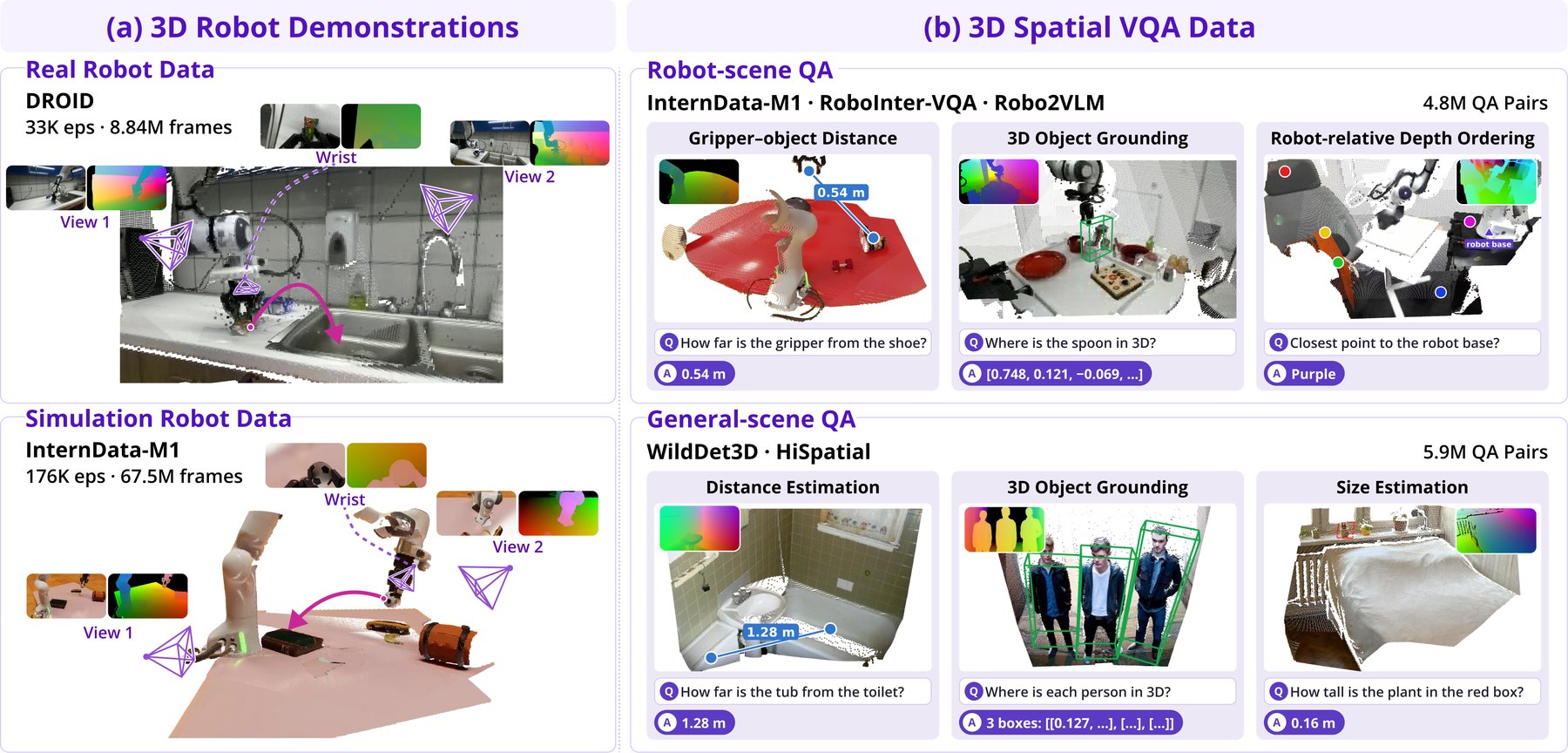
We add pointmap-conditioned 3D spatial VQA to supervise geometric understanding directly.
Questions ask the model to locate objects in 3D, estimate metric distances, and reason about spatial relationships.
Our training corpus pairs pointmaps with 76.3 million robot demonstration frames and 10.7 million 3D spatial VQA
examples, bringing action prediction and spatial understanding into joint training.
The pointmap-paired corpus. (a) Robot demonstrations from DROID (real) and InternData-M1 (simulation), three
cameras fused into one robot-base scene. (b) 3D spatial VQA: robot-scene questions in the robot frame and general-scene
questions in a pseudo-base frame, with answers that are 3D boxes, metric distances, sizes and orderings.
Examples from the corpus
Training samples shown as the model sees them: each camera's RGB image with its pointmap, and every pixel placed in one 3D frame.
Drag to orbit, scroll to zoom, right-drag to pan.
03
Training spatial understanding and continuous control
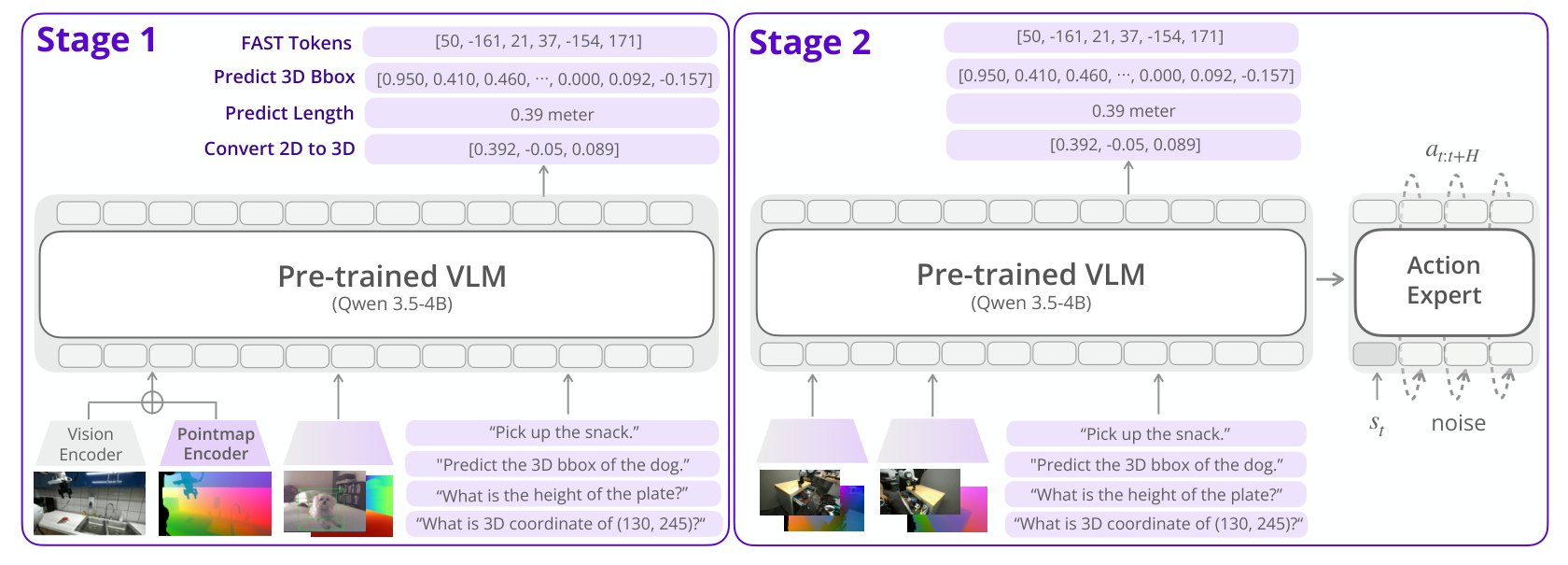
PointmapVLA follows a two-stage training process.
Architecture and recipe. RGB and aligned pointmaps go through separate encoders and are fused patch-wise.
Both stages keep the 3D spatial VQA and discrete-action paths; Stage 2 adds the continuous action expert.
Stage 1
Learn to read pointmaps
The vision-language backbone learns from two kinds of examples at once: spatial questions answered from the pointmaps, and
robot actions written as discrete tokens. Both are predicted as text, so a single next-token loss trains them together.
Stage 2
Add continuous actions
A flow-matching action expert is attached to the backbone and trained with it to output smooth, continuous action chunks.
The Stage 1 losses stay on, so the model keeps practising spatial reasoning while it learns precise control.
04
Results
Simulation
PointmapVLA achieves strong performance across standard manipulation tasks, perturbed environments, and kitchen
tasks requiring precise spatial interactions.
LIBERO99.0%Standard manipulation tasks
LIBERO-Plus92.4%Visual, spatial, and linguistic perturbations
RoboCasa78.2%24 kitchen manipulation tasks
PointmapVLA achieves the highest success rates on LIBERO-Plus and RoboCasa.
LIBERO-Plus is evaluated using the LIBERO-fine-tuned checkpoint without additional fine-tuning.
LIBERO & LIBERO-Plus
Method
LIBERO
LIBERO-Plus
WAMs
Cosmos-Policy
98.5
82.2
ABot-M0.5
99.4
83.4
VLAs
InternVLA-A1.5
98.9
84.8
Qwen-RobotManip
99.1
89.0
Qwen-RobotManip-Context
99.2
91.4
Geometry-aware WAMs
GAM
97.6
85.5
GIFT-WAM-IDM
98.5
87.8
Flex-π
98.5
88.6
Geometry-aware VLAs
Spatial Forcing
98.5
29.1
ABot-M0
98.6
80.5
PointmapVLA (Ours)
99.0±0.1
92.4±0.3
RoboCasa
Method
Success (%)
WAMs
UWM
60.8
DreamZero
62.4
Cosmos Policy
67.1
VLAs
RLDX-1
70.6
Xiaomi-Robotics-1
74.5
Geometry-aware WAMs
GAM
69.4
DeVA
72.0
SA-WAM
76.6
Geometry-aware VLAs
GeoPredict
52.4
SeeR-VLA
61.5
PointmapVLA (Ours)
78.2±0.9
Success rates (%), mean ± std over three evaluation runs for PointmapVLA (paper Tables 1 and 2). Best, second best.
Full tables: all baselines, per suite, per perturbation and per task
LIBERO
Method
Spatial
Object
Goal
Long
Avg.
WAMs
GE-Act
98.2
97.6
95.8
94.4
96.5
Fast-WAM
98.2
100.0
97.0
95.2
97.6
ImageWAM
97.2
99.2
98.8
98.4
98.4
Cosmos-Policy
98.1
100.0
98.2
97.6
98.5
ABot-M0.5
100.0
99.8
99.4
98.4
99.4
VLAs
OpenVLA
84.7
88.4
79.2
53.7
76.5
π0-FAST
96.4
96.8
88.6
60.2
85.5
π0
98.0
96.8
94.4
88.4
94.4
UniVLA
96.5
96.8
95.6
92.0
95.2
π0.5
98.8
98.2
98.0
92.4
96.9
GR00T N1.6
97.7
98.5
97.5
94.4
97.0
OpenVLA-OFT
97.6
98.4
97.9
94.5
97.1
RIPT-VLA
98.6
98.6
99.0
93.8
97.5
RLDX-1
98.0
99.3
98.4
95.3
97.8
X-VLA
98.2
98.6
97.8
97.6
98.1
ACoT-VLA
98.6
99.0
99.4
97.0
98.5
InternVLA-A1.5
98.6
99.8
98.6
98.4
98.9
Qwen-RobotManip
–
–
–
–
99.1
Qwen-RobotManip-Ctx
–
–
–
–
99.2
Geometry-aware WAMs
GAM
98.6
99.6
97.4
94.6
97.6
GIFT-WAM-IDM
99.0
100.0
98.6
96.4
98.5
SG-WAM
99.4
99.4
98.2
97.8
98.7
Flex-π
99.6
99.8
98.6
96.0
98.5
Flex-π*
99.2
99.8
99.0
98.6
99.2
Geometry-aware VLAs
Evo-Depth
95.6
99.2
95.6
91.3
95.4
HoloBrain-0-GD
97.8
98.2
95.2
95.6
96.7
GIFT-VLA
99.0
99.2
98.4
94.8
97.9
Spatial Forcing
99.4
99.6
98.8
96.0
98.5
ABot-M0
98.8
99.8
99.0
96.6
98.6
PointmapVLA (Ours)
99.4
99.5
99.3
97.9
99.0
Success rates (%) per suite (paper Table 9).
LIBERO-Plus
Method
Camera
Robot
Lang.
Light
Backgr.
Noise
Layout
Total
WAMs
Fast-WAM
16.4
44.5
68.9
78.2
53.7
37.7
60.7
51.5
VLA-JEPA
63.3
67.1
85.4
95.6
93.6
66.3
85.1
79.5
Cosmos-Policy
75.8
63.3
81.7
96.5
88.9
92.7
82.2
82.2
ImageWAM
80.8
50.3
91.4
98.1
85.5
93.8
80.5
83.1
ABot-M0.5
70.5
87.4
88.6
94.0
89.7
75.5
85.2
83.4
VLAs
OpenVLA
0.8
3.5
23.0
8.1
34.8
15.2
28.5
15.6
UniVLA
1.8
46.2
69.6
69.0
81.0
21.2
31.9
42.9
π0
13.8
6.0
58.8
85.0
81.4
79.0
68.9
53.6
π0-FAST
65.1
21.6
61.0
73.2
73.2
74.4
68.8
61.6
RIPT-VLA
55.2
31.2
77.6
88.4
91.6
73.5
74.2
68.4
OpenVLA-OFT
56.4
31.9
79.5
88.7
93.3
75.8
74.2
69.6
π0.5
78.4
73.6
80.8
96.2
94.1
89.0
84.5
84.4
InternVLA-A1.5
83.1
55.1
86.9
96.4
98.2
95.6
85.2
84.8
ACoT-VLA
72.6
82.6
87.5
97.7
96.5
87.8
88.1
86.6
RLDX-1
75.0
91.8
92.2
97.1
95.5
80.3
80.7
86.7
Qwen-RobotManip
87.2
75.5
85.6
96.6
97.7
97.7
87.3
89.0
Qwen-RobotManip-Ctx
89.9
83.9
86.5
98.6
99.9
97.9
87.5
91.4
Geometry-aware WAMs
SG-WAM
54.8
78.3
81.7
96.5
88.9
90.7
85.3
81.3
GAM
83.1
70.0
84.8
97.2
94.3
95.3
79.1
85.5
GIFT-WAM-IDM
78.7
80.5
90.2
99.0
89.2
97.2
83.3
87.8
Flex-π
89.1
72.7
84.5
94.6
96.3
98.9
87.3
88.6
Geometry-aware VLAs
Spatial Forcing
20.1
13.4
40.9
29.1
33.4
25.7
39.3
29.1
Evo-Depth
47.2
49.2
78.9
88.1
76.4
77.6
69.6
69.6
HoloBrain-0-GD
65.5
58.2
78.7
88.1
90.3
66.9
79.5
74.0
GIFT-VLA
57.7
63.7
88.6
98.5
96.9
82.5
80.3
79.6
ABot-M0
60.4
67.9
86.4
96.2
91.6
86.4
82.6
80.5
PointmapVLA (Ours)
88.0
83.7
92.6
99.0
98.8
99.3
88.9
92.4
Zero-shot success rates (%) per perturbation type (paper Table 10), with the LIBERO-fine-tuned checkpoint and no additional fine-tuning.
RoboCasa
Method
Avg. success (%)
VLAs
π0.5
62.1
π0
62.5
π0-FAST
63.6
GR00T N1.5
64.1
GR00T N1.6
66.2
RLDX-1
70.6
Xiaomi-Robotics-1
74.5
WAMs
UVA
50.0
UWM
60.8
DreamZero
62.4
Cosmos Policy
67.1
World2Act
72.6
Geometry-aware WAMs
GAM
69.4
DeVA
72.0
SA-WAM
76.6
X-WAM†
79.2
Geometry-aware VLAs
GeoPredict
52.4
SeeR-VLA
61.5
PointmapVLA (Ours)
78.2
Task
Success (%)
CloseDoubleDoor
96.7±1.2
CloseDrawer
97.3±1.2
CloseSingleDoor
100.0±0.0
CoffeePressButton
92.7±1.2
CoffeeServeMug
85.3±4.2
CoffeeSetupMug
46.0±2.0
OpenDoubleDoor
68.0±2.0
OpenDrawer
93.3±1.2
OpenSingleDoor
78.7±3.1
PnPCabToCounter
65.3±3.1
PnPCounterToCab
66.7±1.2
PnPCounterToMicrowave
40.0±7.2
PnPCounterToSink
81.3±2.3
PnPCounterToStove
80.7±6.1
PnPMicrowaveToCounter
44.0±3.5
PnPSinkToCounter
84.7±5.0
PnPStoveToCounter
79.3±1.2
TurnOffMicrowave
100.0±0.0
TurnOffSinkFaucet
94.7±1.2
TurnOffStove
40.7±8.3
TurnOnMicrowave
88.7±2.3
TurnOnSinkFaucet
83.3±1.2
TurnOnStove
80.7±5.0
TurnSinkSpout
88.0±2.0
Average
78.2±0.9
Average success (%) over the 24 atomic kitchen tasks, 300 demonstrations per task (paper Tables 11 and 12; right: PointmapVLA per task, mean ± std over three evaluation runs).
†X-WAM uses RoboCasa data during pretraining and is not directly comparable.
Simulation rollouts
Successful evaluation episodes of the paper checkpoints. Pick a benchmark and a task.
Rollout videos are being prepared.
Real-world manipulation
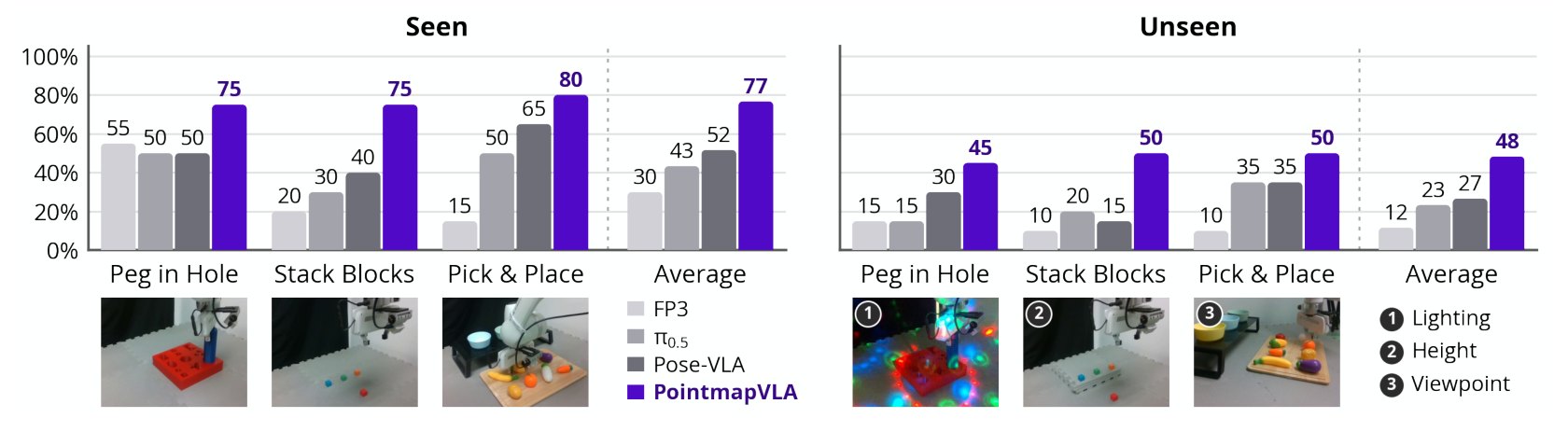
We evaluate three tasks: peg insertion, block stacking, and spatially instructed pick-and-place. Unseen conditions
introduce changing illumination, new target heights, and a new external camera viewpoint, respectively.
PointmapVLA achieves 77% average success under seen conditions and 48% under unseen conditions, compared with
52% and 27% for Pose-VLA, the strongest baseline on average. PointmapVLA performs best on each task under both conditions.
Real-robot results. Success rate (%) per task under seen and unseen conditions, 20 rollouts per task and condition; all policies fine-tuned on the same demonstrations.
Clips are qualitative examples, not the success-rate sample; playback is real time (1×). Baseline clips may come from a
different evaluation case of the same task and condition when no recording of the same case exists.
Robustness to camera occlusion
We also test pick-and-place while physically blocking external cameras.
3D grounding under occlusion
Asked for the target’s 3D box, PointmapVLA (purple) keeps producing one from the remaining views; Pose-VLA (orange)
gives no box from an occluded camera. Pick an object and an occlusion setting; drag to rotate, scroll to zoom.
05
Analysis
Robot-centric geometry
Robot-base coordinates improve manipulation. Robot-base pointmaps reach 73.6% on RoboCasa, above camera-frame pointmaps (71.2%) and RGB alone (67.9%).
Input
SR (%)
None (RGB-only)
67.9±0.1
Depth
70.0±0.6
Depth + ray
70.9±0.3
Pointmap (camera)
71.2±0.9
Pointmap (robot base)
73.6±0.3
Paper Table 6 · RoboCasa success rates (%)
Depth and depth-plus-ray inputs also improve over RGB, but stay below robot-base pointmaps.
Pointmap encoder initialization
Encoder initialization matters. Initializing the pointmap encoder from the VLM’s pretrained RGB encoder performs best among the tested designs.
Encoder
Pretrained
RGB
Pointmap
SigLIP2
✓
65.3±1.1
70.2±0.6
DINOv3
✓
66.8±0.6
70.8±0.7
MoGe-3
✓
68.3±0.6
69.8±0.5
Linear embed.
×
–
66.6±0.5
Qwen3.5
×
–
63.0±0.4
Qwen3.5 (Ours)
✓
–
73.6±0.3
Paper Table 5 · RoboCasa success rates (%); RGB / Pointmap = what the encoder is fed
With identical auxiliary encoders, pointmap inputs also beat additional RGB inputs. These input and encoder comparisons use direct downstream fine-tuning without PointmapVLA pretraining.
Spatial supervision
Spatial supervision complements action supervision. Robot-only pretraining already helps; adding 3D spatial VQA raises success further in every evaluated setting.
Pretrain
Simulation
Real world
RoboCasa
LIBERO-Plus
Seen
Unseen
None
73.6±0.3
82.6±0.1
–
–
Robot
76.4±0.1
88.2±0.9
70
38
Robot + VQA
78.2±0.9
92.4±0.3
77
48
Paper Table 7 · success rates (%) across pretraining strategies
Demonstration efficiency
With 100 demonstrations per task, PointmapVLA reaches 76.5% on RoboCasa, above the RGB-only variant with 300 (71.6%).
RGB-only fine-tuningRGB + pointmap fine-tuning
Both variants start from the same pointmap-pretrained checkpoint and share the fine-tuning schedule; the RGB-only variant removes pointmaps during fine-tuning and evaluation.